Subfloor prep. The work that decides whether a new floor lasts.
Every flooring failure that's not a manufacturing defect comes from the subfloor. Wet slab. Out-of-flat substrate. Bouncing joists. We measure flatness with a 10-foot straightedge, moisture with a calcium-chloride test or in-situ probe, and structural soundness before any new flooring goes down. If the prep isn't right, no floor on top of it will last.
What's included in this service?
- Slab moisture testing (calcium chloride and in-situ probe per ASTM)
- Slab flatness check with 10-foot straightedge
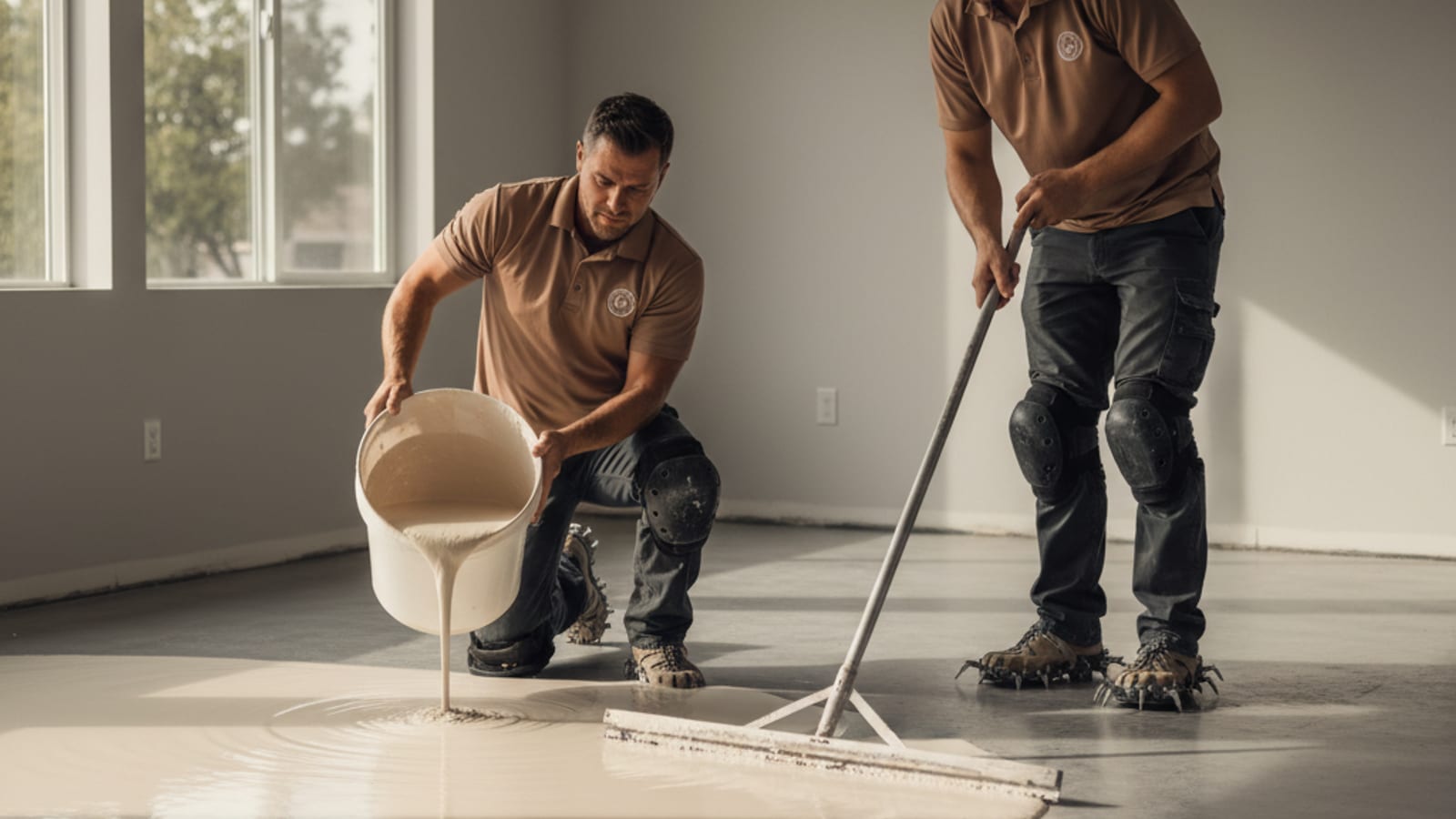
- Self-leveling compound pour for low spots
- Diamond grinding for high spots and bond breakers
- Plywood overlay over uneven slab or wood subfloor
- Moisture mitigation coatings for slabs above spec
- Subfloor screw-down to eliminate squeaks before refloor
- Demolition of old flooring and adhesive removal
When do you need this service?
- New floor is being installed and old subfloor is questionable
- There's a hump, a dip, or a soft spot
- Old adhesive (cutback, urethane) is still on the slab
- Slab moisture is high and the new floor will not handle it
- The previous floor failed and you do not know why
What do homeowners ask about Subfloor?
How flat does the subfloor need to be?
Most modern flooring (LVP, laminate, engineered) calls for 3/16 inch in 10 feet. Large-format tile is 1/8 inch in 10 feet. Solid hardwood is 3/16 inch in 6 feet. We measure with a 10-foot straightedge and feeler gauges. Out-of-tolerance areas get self-leveling compound or grinding.
How do you test slab moisture?
Two methods. Calcium chloride (ASTM F1869) measures moisture vapor emission rate over 60 to 72 hours and gives a number in pounds per 1,000 square feet per 24 hours. In-situ relative humidity probe (ASTM F2170) measures moisture inside the slab itself and is more accurate. We default to in-situ probes on slab installs.
Do I always need a moisture barrier on slab?
If the slab is above the manufacturer's moisture spec, yes. For LVP, most manufacturers allow up to 80 to 85% RH or 5 lbs MVER. Above that, the crews we send apply a moisture-mitigation coating before flooring. Skipping this step is the most common cause of LVP edge curling and adhesive failure on slab.
What does adhesive removal involve?
Old cutback, urethane, or vinyl adhesive needs to come off before new flooring goes down. We use a combination of mechanical scraping, diamond grinding, and chemical adhesive removers (low-VOC) depending on what's on the slab. Asbestos cutback (pre-1980 homes sometimes) requires specialty abatement, we will identify it and refer.
Where do we offer Subfloor in San Diego County?
We provide subfloor in every city and community in San Diego County. Pick your city for local climate notes and service specifics.
See subfloor in all 67 cities
Need subfloor in San Diego County?
Call for a free quote. Most work scheduled within the week.