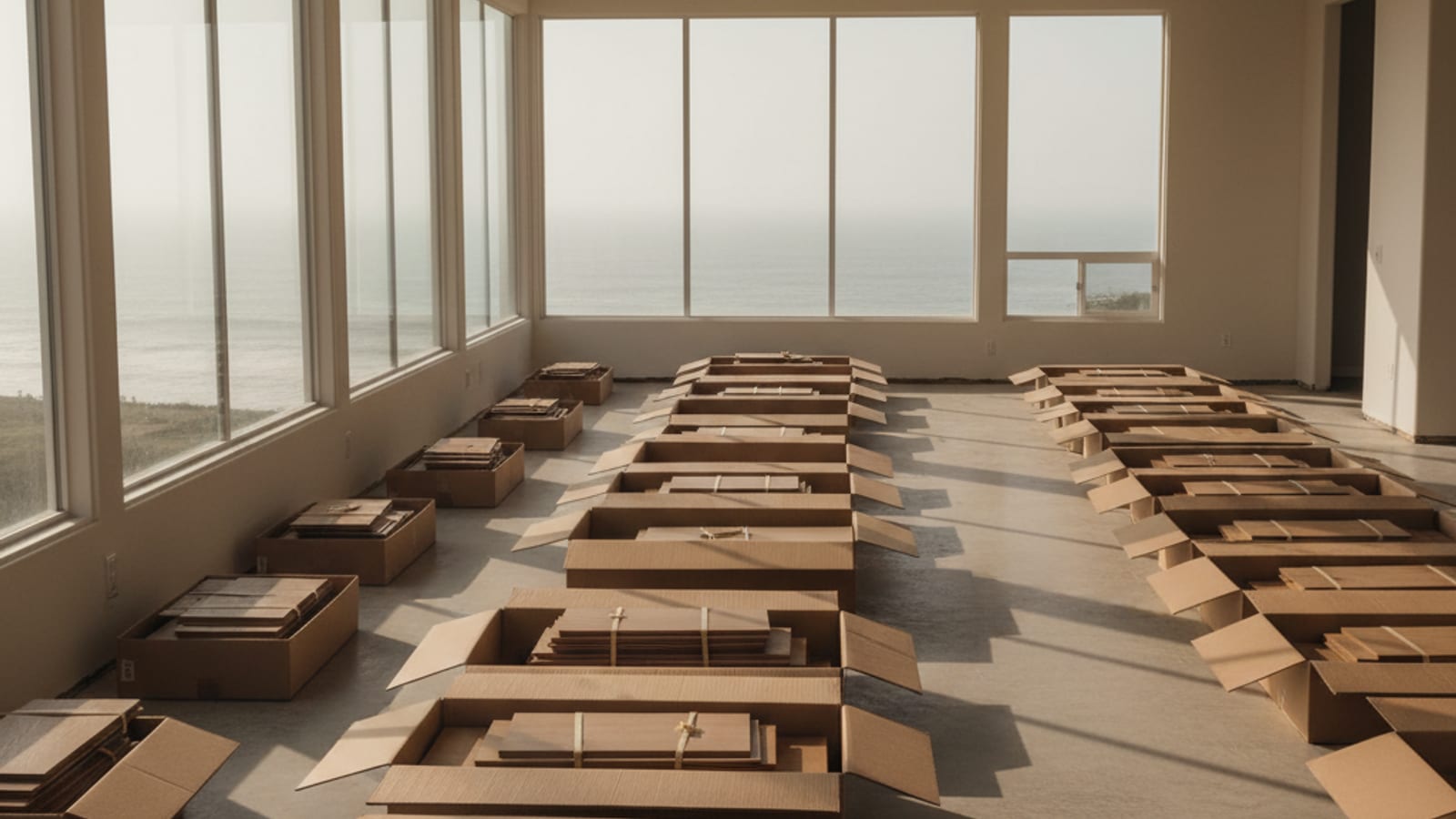
Most failed hardwood installs in coastal San Diego come from the same single mistake: acclimation was rushed. The boards were delivered Friday afternoon, installed Monday morning, and by next winter the floor is gapping or cupping. The product wasn’t bad. The contractor wasn’t lazy on the install. The wood just didn’t get a chance to find equilibrium with the room it was going to live in.
This is the process we use on every coastal install: what we measure, how long we wait, and why the timeline isn’t negotiable.
Why acclimation matters more on the coast
Hardwood is hygroscopic, it absorbs and releases moisture with the surrounding air. A board sitting in a delivery truck in Vista on a dry afternoon has different moisture content than the same board sitting in your Encinitas living room with HVAC running.
If you nail the floor down at the wrong moisture content, one of two things happens over the following months:
The boards lose moisture and shrink. You see gaps between boards by next winter. Wide-plank floors show this most.
The boards gain moisture and expand. You see cupping (edges higher than the center) or, in extreme cases, buckling. The floor is fighting itself.
The fix once it’s installed is hard. You can sometimes sand cupping flat once the moisture stabilizes, but the boards are stressed and prone to cracking. Severe cases require replacement.
Coastal San Diego compounds the problem because ambient humidity runs high year-round, 60 to 80% relative humidity is normal in homes within 2 miles of the ocean. Inland zones run 30 to 50%. Solid hardwood that acclimated to inland conditions and then was installed in a coastal home will absorb moisture and expand. Acclimation matters more here than almost anywhere else in the county.
The right process
Step 1: Deliver the wood at least 5 to 10 days before install
This is the non-negotiable part. Coastal homes need 8 to 10 days. Inland homes can usually do 5 to 7. We schedule deliveries to land at least a week before the install date, sometimes more if the home is at the very coast.
The boxes go into the room where the floor is being installed. Not the garage. Not a hallway. The actual room.
Step 2: Open the boxes and cross-stack the boards
Unopened boxes don’t acclimate, the wood is sealed against the same conditions it was packaged in. We open every box on day one of acclimation.
Boards get cross-stacked: small piles, alternating direction every few boards, with airflow gaps between rows. The goal is to expose every face of every board to the room air.
This part is often skipped on rushed installs. A delivery driver drops 30 sealed boxes in the corner, the contractor calls it “acclimating,” and the boards inside the boxes are getting nothing. We cross-stack on day one.
Step 3: Run HVAC at the conditions the home will live in
Acclimation only works if the room is at its long-term operating conditions. If the homeowner runs HVAC at 70°F in summer and 65°F in winter, we run HVAC at those temperatures during acclimation. Same for humidity if there’s a whole-home humidifier or dehumidifier.
If acclimation happens with windows open and no HVAC, the wood acclimates to outdoor conditions, not indoor. Then once HVAC kicks back on after install, the boards move again. Same failure mode as no acclimation at all.
Step 4: Pin-meter board moisture and subfloor moisture before nailing
This is the measurement that separates careful installs from sloppy ones. We use a pin-style moisture meter: two probes that read the moisture content inside the board, not just at the surface.
We measure:
- Random sample of hardwood boards from different boxes and different parts of the stack. Multiple readings on each board (start, middle, end).
- Subfloor moisture in multiple locations across the floor, including near exterior walls.
The two readings have to agree within 4% relative moisture content. If they don’t, more time is needed. Sometimes the answer is to extend acclimation by another two or three days. Sometimes it’s to add a vapor barrier. Sometimes it’s to address a moisture issue in the subfloor before any flooring goes down.
We will not nail a floor where the wood and subfloor differ by more than 4%. There is no clever workaround for this. The math of moisture migration is what it is.
What “rushed” looks like in practice
Common red flags from contractors who don’t take acclimation seriously:
“We deliver the day before and start the next morning.” That’s not acclimation. That’s storage.
“Acclimation is included, the wood sits in the garage for a week.” The garage isn’t conditioned space. The boards acclimate to outdoor conditions, not indoor. Wrong.
“We don’t pin-meter, we just go by feel.” A pin meter costs $200. If a contractor is doing hardwood for a living and doesn’t own one, they’re not measuring what matters.
“This product is engineered, so acclimation doesn’t matter.” Engineered is more dimensionally stable than solid, but it still benefits from 24 to 72 hours on site to equilibrate. “Doesn’t matter” is overstated.
If you hear any of these from a quote, the price is probably good but the install will be the problem.
What we change for coastal homes specifically
Three modifications we make on every install within 2 miles of the ocean:
Longer acclimation. 8 to 10 days minimum, sometimes more. We’ve extended to 14 days on a few jobs where the readings didn’t stabilize earlier.
Slightly tighter expansion gaps. Coastal humidity stays high year-round, so the boards run wetter than inland. We size expansion gaps for less seasonal swing, the floor won’t dry out as much, so it won’t shrink as much.
Engineered hardwood as default recommendation. For most slab-on-grade coastal homes, we recommend engineered over solid. The dimensionally stable core handles humidity better, and glue-down installs over slab eliminate the need for plywood overlay.
If you’re set on solid hardwood in a coastal home, it’s possible, but the prep work and timeline are different than an inland install, and we price accordingly.
What about engineered hardwood?
Engineered hardwood is more forgiving on acclimation but not exempt. We still deliver 2 to 4 days early and pin-meter before install. The variation tolerance is wider (engineered cores move less than solid wood), but the principle is the same: the wood should equilibrate to the room before it’s nailed or glued down.
Quality 5/8-inch engineered with a 4mm wear layer is genuinely a great fit for coastal San Diego. It looks and feels like real wood (because the wear layer is real wood), it tolerates humidity, and it can be refinished once or twice over its life.
More on this in our engineered hardwood service page.
How to vet a contractor on acclimation
Three questions to ask any hardwood contractor before signing:
- How many days of acclimation are budgeted in this quote? Anything less than 5 is rushed.
- Where will the boards acclimate? “In the room being installed” is the right answer.
- Do you pin-meter board and subfloor moisture before nailing? “Yes, with a pin meter” is the right answer. “We just go by feel” is a no.
If a contractor’s process matches all three, the floor will probably last. If it doesn’t, you’re paying full price for an install that’s likely to gap or cup within 18 months.
Want a real consult?
Free in-home measure across all 67 San Diego County cities, including a written acclimation and install schedule for your specific home. We bring product samples and a moisture meter, and we’ll show you the readings before we leave.
Call (858) 925-5546 or request a quote.