Most homes built in San Diego County after 1990 sit on a concrete slab. If yours does, the engineered vs. solid hardwood question is mostly already decided for you. Here’s why, and what the actual options look like.
The short version
Slab home + you want real wood = engineered hardwood. It’s that simple in most cases. Solid hardwood directly over slab cups within 12 to 24 months because of moisture transmission. The fix is plywood overlay first (which adds $2.50–$4 per square foot and an inch of floor height), or you switch to engineered.
Wood subfloor home = either works. Solid hardwood lasts longer, refinishes more times, and feels more substantial. Engineered is faster to install and works well over radiant heat. Go with what fits your budget and timeline.
Why solid hardwood doesn’t work directly on slab
Concrete slabs in San Diego, even properly cured ones, release moisture vapor. The vapor passes through the slab into whatever sits on top of it. Hardwood is hygroscopic; it absorbs that moisture and expands.
Over months, the boards cup (edges higher than the center) as the bottoms absorb more moisture than the tops. In severe cases, they buckle. The fix once it’s installed is hard: sanding flat just brings the cups back as moisture continues.
The plywood-overlay workaround creates a barrier and gives the hardwood something to nail into. It works, but it raises the floor height, which throws off door clearances, transitions, and trim. For most homeowners, switching to engineered is cleaner.
How engineered hardwood handles slab
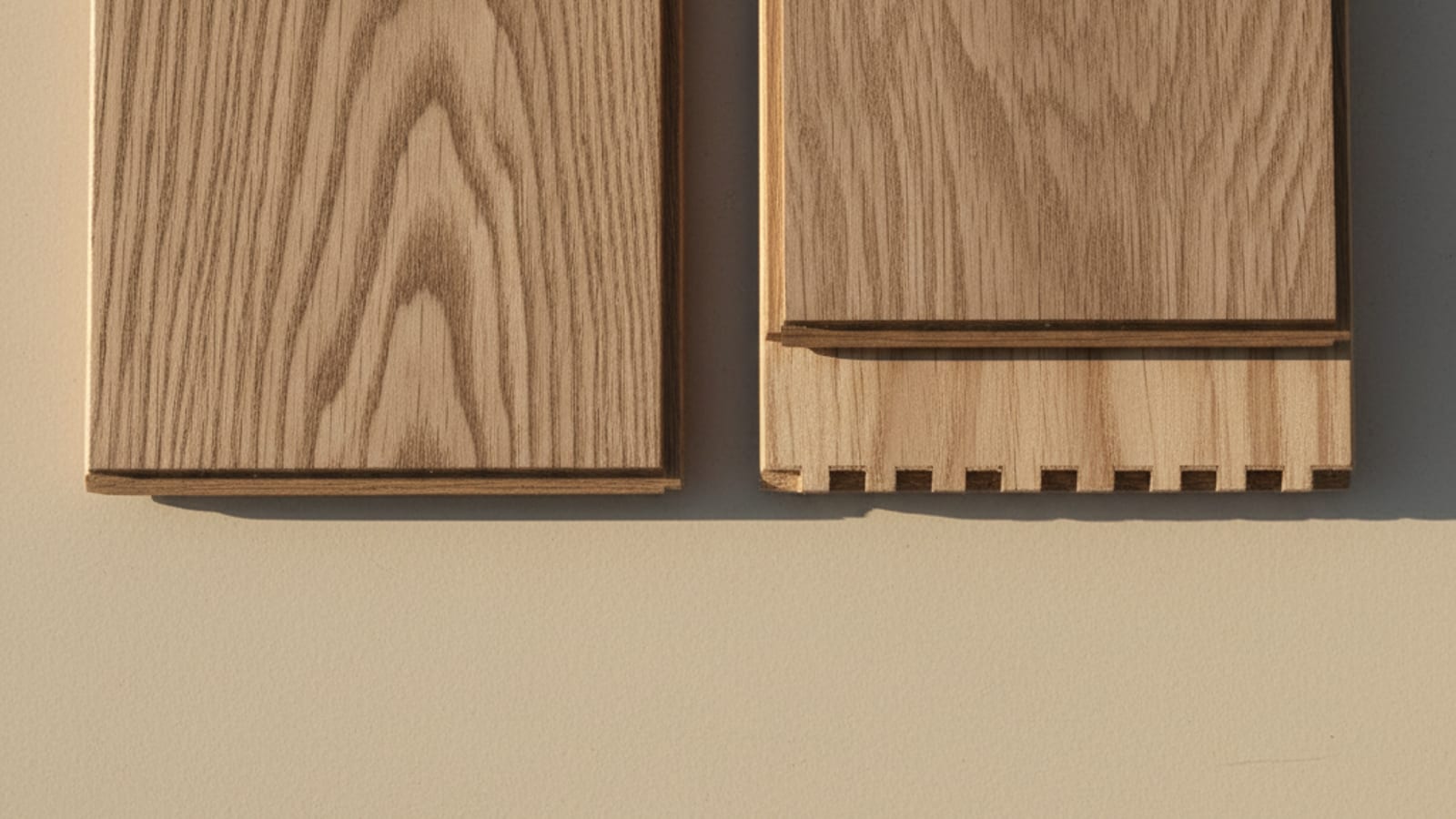
Engineered construction:
- Top layer: A real hardwood veneer, typically 2mm to 6mm thick. This is the wear layer, what you see and walk on.
- Core: Multiple plies of plywood or HDF arranged in cross-grain orientation for dimensional stability.
- Backing: Often birch ply.
The cross-grain core resists the expansion-contraction stress that destroys solid hardwood over slab. You get real wood feel and look (because the wear layer is real wood) with the stability of a manufactured product.
Quality engineered with a 4mm+ wear layer can be sanded and refinished one or two times over its life. Cheaper engineered with a 1mm or 2mm wear layer should be replaced rather than refinished.
Install methods over slab
Three options for engineered over concrete:
1. Glue-down Trowel-applied vapor-barrier adhesive, plank pressed in. Quietest underfoot, most permanent, feels closest to solid hardwood. Best for primary residences where the floor will live for decades.
2. Float Click-lock or tongue-and-groove engineered installed over a quality 3-in-1 underlayment with vapor barrier. Faster and cheaper to install, easier to repair (lift planks individually), but slightly hollow-feeling underfoot. Good for rentals and faster turnarounds.
3. Nail-down (rare on slab) Requires plywood overlay first, which defeats the purpose of choosing engineered for slab. We don’t recommend this approach.
For most San Diego slab homes, glue-down is the right call.
Wear layer matters most
If you take one thing from this post, it’s this: the wear layer thickness is what determines how long an engineered floor lasts and whether it can be refinished.
| Wear layer | Lifespan | Refinishes |
|---|---|---|
| 1mm | 10–15 years | Replace, don’t refinish |
| 2mm | 15–20 years | One light recoat possible |
| 3mm | 20–30 years | One full refinish |
| 4mm+ | 30–50+ years | Two full refinishes |
When you’re comparing engineered products at retail, ask for the wear layer specifically. “Real wood top” is meaningless without the thickness number. Cheap retail engineered is often 1mm or 2mm, lifespan-limited.
We carry samples from manufacturers across the wear-layer range and tell you specifically which is which.
What about cost?
Mid-range engineered hardwood in San Diego runs $8 to $14 per square foot installed including:
- Slab moisture testing (ASTM F2170 in-situ probe)
- Glue-down install with vapor-barrier adhesive
- Trim, transitions, and stair nosings to match
- Demo and haul-away of existing flooring
For comparison, solid hardwood on a wood subfloor runs $9 to $16 per square foot, and solid hardwood on slab (with required plywood overlay) runs $11 to $18.
For most slab homes, engineered is roughly 15-30% cheaper than the solid-hardwood-with-overlay path, and the result is better long-term.
Aesthetic concerns
Modern engineered hardwood looks identical to solid at floor level. Quality European-oak engineered with a wire-brushed finish reads as premium real wood. Because it is. The plank edges are typically microbeveled (slight V-groove between boards), which some homeowners prefer for the defined-plank look.
Site-finished solid hardwood has tighter seams and a smoother, more continuous surface. If that’s the aesthetic you want, you’re back to either solid-on-wood-subfloor or solid-on-plywood-overlay.
How to decide
If you’re choosing between engineered and solid for a slab home, walk through these questions:
- Is it slab or wood subfloor? Slab → engineered. Wood subfloor → either.
- How long do you plan to be in the home? 20+ years → solid (if eligible) wins on longevity. Under 15 → engineered is fine.
- What’s your budget per square foot installed? Under $10 → engineered. $10–14 → either. $14+ → solid (if eligible).
- Do you want to refinish later? Yes → 4mm+ engineered or solid. No → 2-3mm engineered is fine.
- Are you doing radiant heated floors? Yes → engineered (solid hardwood doesn’t work over radiant).
Want to see samples?
Free in-home consult across all 67 San Diego County cities. We bring engineered samples in a range of wear layers and species so you can see them on your slab, in your light, before committing. Slab moisture probe done at the consult.
Call (858) 925-5546 or request a quote.