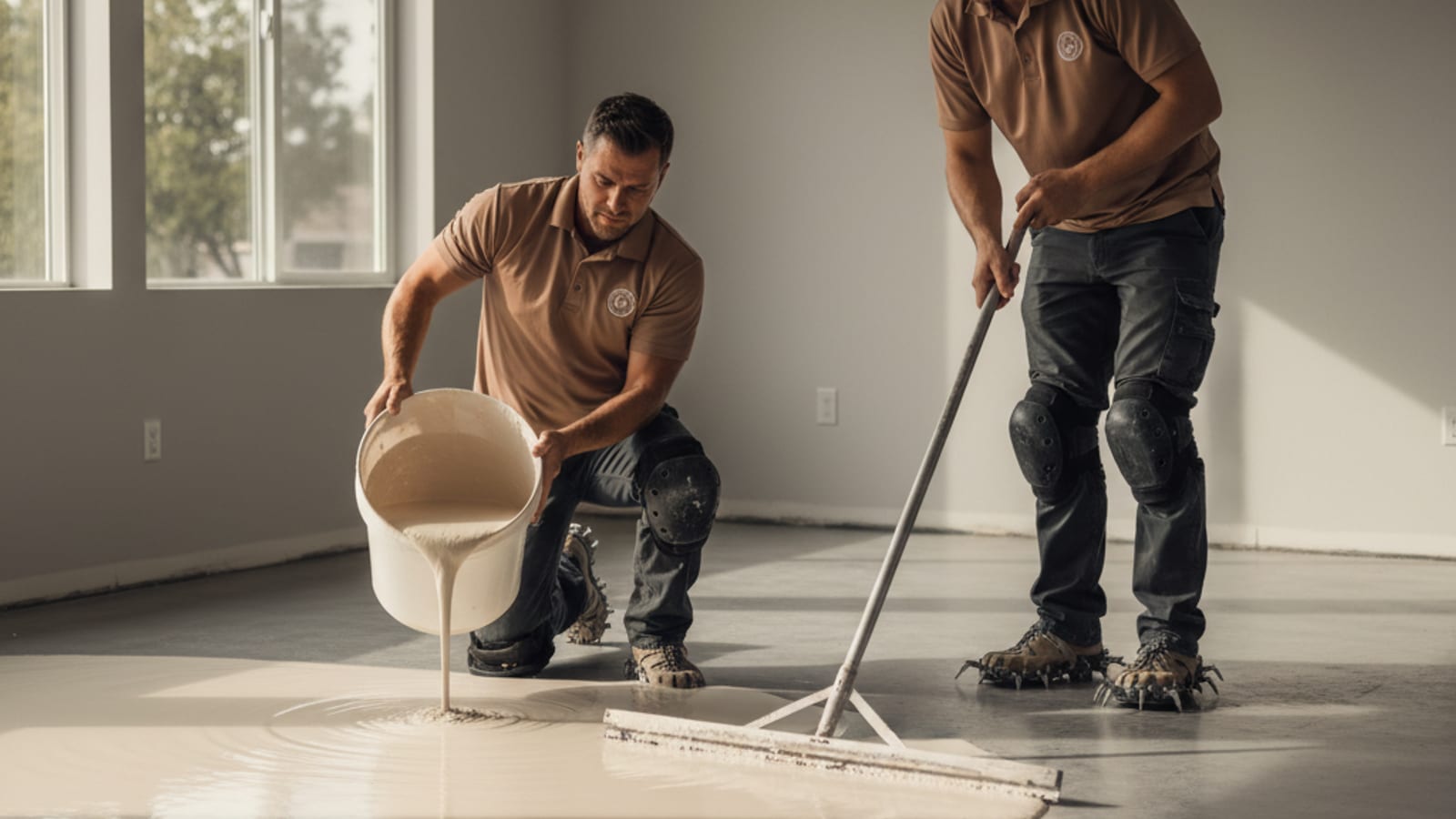
Floor leveling in San Diego runs roughly $2 to $8 per square foot, depending on method. Most homes need a self-leveling compound over the slab, which lands around $2 to $4 per square foot. Bigger dips, joist problems, or full mortar beds cost more. The work matters most here because so many San Diego homes sit on concrete slabs that settle unevenly, and an out-of-level floor will telegraph through any flooring you put on top of it.
Why San Diego floors go out of level
Two things drive most leveling work in this county: slab settling and old subfloor wear.
A huge share of homes built from the 1960s on are slab-on-grade, poured concrete directly on the dirt. Over decades, the soil under one corner compacts faster than another. The slab follows. You end up with a slow dip across a room, sometimes half an inch over fifteen feet. You feel it as a roll underfoot before you ever see it.
Coastal and canyon lots make this worse. Expansive clay soils in places like Scripps Ranch, La Mesa, and parts of Chula Vista swell when wet and shrink when dry. That seasonal movement works the slab. Hillside cut-and-fill lots in El Cajon and Poway settle differently on the cut side versus the fill side.
Older raised-foundation homes near the coast have a different problem. Decades of marine-layer humidity and the occasional plumbing leak soften subfloor plywood and sag the joists. The floor dips between supports.
How level does a floor actually need to be?
Most flooring manufacturers spec the subfloor flat to within 3/16 inch over a 10-foot span. Tile is stricter, closer to 1/8 inch over 10 feet, because rigid tile cracks and grout lines fail when the surface flexes.
That tolerance is tighter than most people expect. A floor that looks flat to the eye routinely fails the straightedge test. We check with a 10-foot level and a laser before we quote, so the number you get is based on real readings, not a guess.
If your floor passes the tolerance, you don’t need leveling, and we’ll tell you so. Paying to level a floor that’s already in spec is money wasted.
The methods, and what each one costs
The right method depends on how far out of level you are and what’s under the floor.
| Method | Best for | Typical cost |
|---|---|---|
| Self-leveling compound | Slab dips up to ~1 inch, fast cure | $2 to $4 / sq ft |
| Grinding high spots | Small high ridges on a slab | $1 to $3 / sq ft |
| Plywood shimming / sister joists | Sagging wood subfloors | $3 to $6 / sq ft |
| Sleeper system or new subfloor | Severe slope, raised foundations | $5 to $8+ / sq ft |
| Mud bed (mortar) under tile | Tile over uneven slab | $4 to $7 / sq ft |
Self-leveling compound is the workhorse for slab homes. It’s a cement-based pour that flows to find its own level, then cures hard in hours. For a typical 1/4 to 1/2 inch dip across a living room, it’s clean and fast.
Grinding handles the opposite problem, a high spot or ridge in the slab. Cheaper than building up, but it only works for small high areas.
Wood subfloors get shimmed, re-screwed, or have sagging joists sistered (a new joist bolted alongside the old one). That’s more carpentry than pour, so the labor runs higher.
The big-number jobs are severe slopes and failing raised foundations, where we build a sleeper system or replace subfloor sections entirely.
What changes the price
Three factors move the number most:
The depth and area of the dip. A shallow dip across one room is cheap. A deep slope across an open floor plan needs more material and sometimes a primer coat first.
Slab versus raised foundation. Slab leveling with compound is usually straightforward. Raised-foundation work means crawlspace access, joist repair, and sometimes addressing the moisture that caused the sag.
Moisture in the slab. This is the San Diego asterisk. Many coastal slabs lack a vapor barrier underneath, so they wick ground moisture up into the floor. We pin-meter and do a calcium chloride or RH probe test before pouring compound, because self-leveler poured over a wet slab can fail to bond or trap moisture under your new floor. If the slab reads wet, we deal with that first, and that adds cost. Skipping it is how a leveling job turns into a flooring failure a year later.
Why this matters more on the coast
Coastal humidity and slab construction stack the deck against an uneven floor.
If you’re installing engineered hardwood or LVP over a slab that isn’t level, the planks flex at every step. Click-lock joints work loose. You get hollow spots and clicking sounds. Over time the locking edges wear and separate. We see this constantly on jobs where someone laid floating floor straight over an unleveled slab to save money.
Tile is less forgiving still. Lay it over a slab that moves and the tiles crack, the grout cracks, and a corner lippage you could feel with a bare foot becomes a chipped edge. A proper mortar bed or self-leveled base under tile near the coast isn’t optional.
Moisture ties it together. A coastal slab that’s both uneven and damp is the worst case. Level it without addressing moisture and you’ve buried the real problem under a new floor. That’s why our leveling quotes near the coast almost always include a slab moisture reading.
Can you DIY floor leveling?
For a small, dry slab with a shallow dip, a handy homeowner can pour self-leveling compound. The product is at any home center, and the pour itself isn’t hard.
What’s hard is everything around the pour. Reading the slab correctly, knowing whether the slab is dry enough, prepping and priming so the compound bonds, and mixing fast enough to pour before it sets. Self-leveler has a short working window. Mix too much, hesitate, and it sets in the bucket.
The expensive mistakes are pouring over a moisture problem and misjudging how much compound a dip actually needs. Either one means tearing it out. For anything beyond a small closet or a clearly dry slab, the labor we add is cheap next to redoing it.
How we quote a leveling job
Every quote starts with a free in-home measure. We bring a 10-foot straightedge and a laser, map the high and low spots, and read slab moisture if it’s a slab home. Then you get a written quote with the method, the square footage, and the price, before anything starts.
No surprise change orders mid-job. If we find a moisture problem or a worse dip than expected once we’re in, we stop and talk before we spend your money.
Leveling is usually step one of a larger flooring project. If you’re putting down new floors, see our subfloor preparation service for how the prep fits the install. If you’re already seeing dips, soft spots, or movement, our guide on the signs you need floor repair in San Diego covers what to watch for.
Frequently asked questions
How much does it cost to level a floor in San Diego?
Most jobs run $2 to $8 per square foot. A self-leveling compound pour over a slab, the most common case here, is usually $2 to $4 per square foot. Sagging wood subfloors and severe slopes cost more because they need carpentry, not just a pour.
How do I know if my floor is level enough for new flooring?
Most floors need to be flat within 3/16 inch over 10 feet, and tile needs closer to 1/8 inch. The eye can’t judge this reliably. A 10-foot straightedge or laser tells you, and we check it for free before quoting.
Why do so many San Diego homes need leveling?
A large share are slab-on-grade, and expansive clay soils plus hillside fill lots cause slabs to settle unevenly over the years. Older raised-foundation homes near the coast sag from decades of humidity and the occasional leak.
Can I just lay flooring over an uneven floor?
You can, but it fails. Floating floors flex and click, click-lock joints separate, and tile cracks. The unevenness telegraphs through whatever you install. Leveling first is cheaper than redoing the floor later.
Do I need to fix slab moisture before leveling?
Often yes, especially near the coast. Many older slabs lack a vapor barrier and wick ground moisture up. We test slab moisture before pouring compound, because pouring over a wet slab can cause bond failure or trap moisture under your new floor.
How long does floor leveling take?
A self-leveling pour cures enough to walk on in a few hours and to install over in 24 to 72 hours depending on depth and the product. Wood subfloor repairs and sleeper systems take longer because of the carpentry involved.
Get a real number for your floor
We cover all 67 San Diego County cities with free in-home estimates. We’ll map your floor with a laser, read slab moisture if it’s a slab home, and give you a written quote with the method and the price before any work starts. No storefront markup, no surprise change orders.
Call (858) 925-5546 or request a quote.