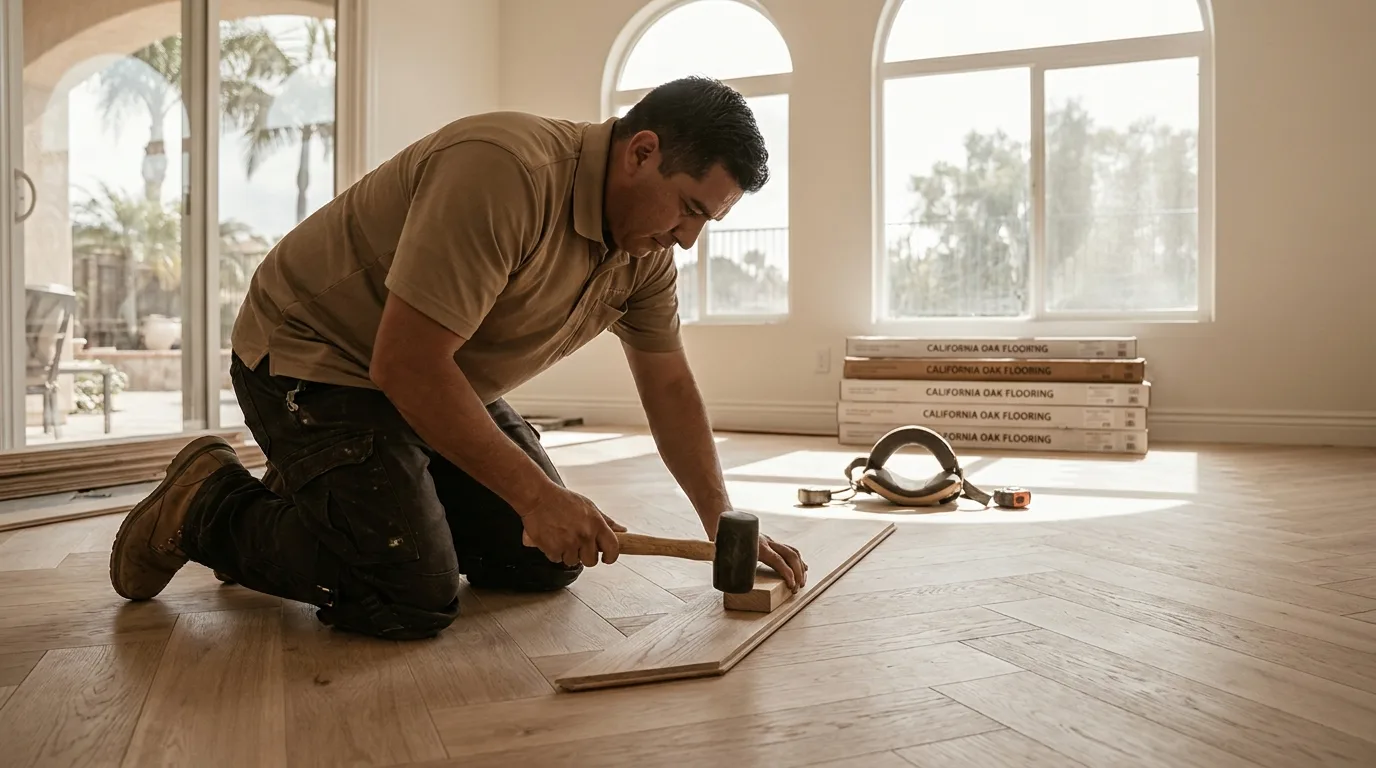
Herringbone flooring san diego homeowners are requesting more than ever, and it’s easy to see why. The angled, interlocking pattern adds a visual depth that straight-lay planks simply can’t match. Before you commit, though, you should know what it costs, which materials work best in San Diego’s slab-heavy housing stock, and where the pattern actually earns its premium.
The short version
- Herringbone adds roughly 30-50% to installation labor compared to straight-lay because of increased cutting and precise layout work.
- Engineered hardwood and luxury vinyl plank (LVP) are the most practical choices for San Diego’s concrete slab homes.
- Solid hardwood herringbone is possible over a wood subfloor, but rare in most SD construction.
- Expect installed prices of $12–$22/sq ft for engineered hardwood herringbone and $7–$14/sq ft for LVP herringbone.
- The pattern shines in entryways, dining rooms, and main living areas of coastal and upscale inland homes.
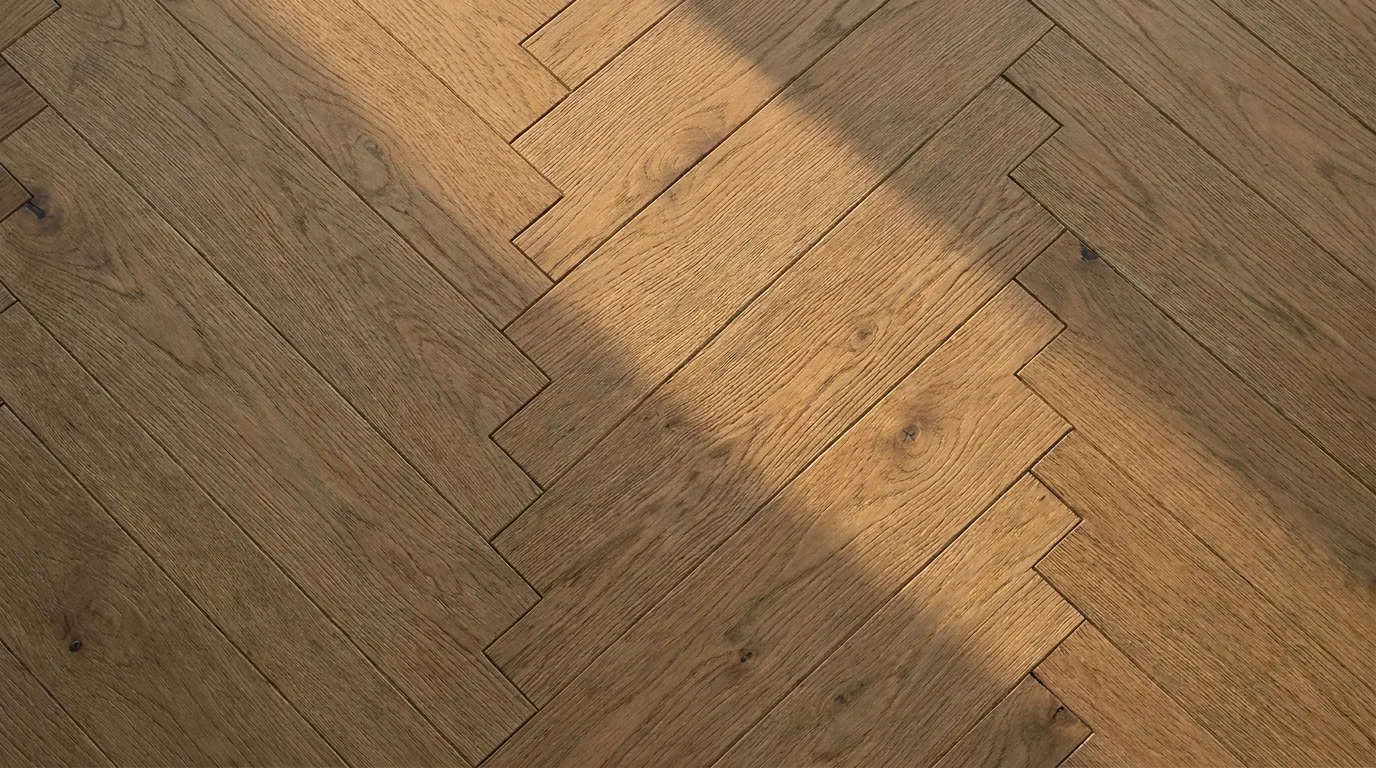
Herringbone vs. chevron: what’s the actual difference?
Both patterns use angled planks, but they connect differently. In a herringbone layout, each plank butts squarely into the side of the next, creating that classic zigzag. In a chevron layout, the plank ends are cut at an angle so the tips of two planks meet at a perfect point, forming a continuous V-shape.
Herringbone is the more common request because standard-length planks can be used. Chevron requires planks cut at the factory to a specific angle, which raises material costs and limits your options. Most San Diego homeowners asking for “that angled wood floor” actually want herringbone.
How much more does herringbone cost than straight-lay?
The labor premium is real. Straight-lay hardwood flooring installation runs $9–$16/sq ft installed for solid or engineered hardwood in San Diego. Add herringbone, and the labor portion alone jumps 30-50% because the installer has to snap a precise center layout line, cut every plank at 45 degrees, and manage a much tighter tolerance for the pattern to stay true across the room.
For engineered hardwood installation in herringbone, budget $12–$22/sq ft installed depending on the wood species and plank width. For luxury vinyl plank installation in herringbone, the range is typically $7–$14/sq ft installed. LVP material is less expensive, but the layout and cutting labor is identical.
Material costs don’t change dramatically for herringbone. You may order 10-15% more material for waste than a straight-lay job, but that’s a modest line item compared to the labor difference.
What materials work for herringbone flooring?
Solid hardwood. This is the classic choice and it looks spectacular. White oak, red oak, and walnut are the most popular species we see in San Diego. The catch: solid hardwood shouldn’t be glued directly to concrete, which rules it out for most San Diego homes built on slabs. If you have a wood subfloor over a crawl space or a raised foundation, solid herringbone is on the table.
Engineered hardwood. This is the practical sweet spot for most San Diego herringbone projects. A real wood veneer over a plywood core means the floor looks and feels like solid wood, but the dimensional stability makes it safe to float or glue over concrete. Species and finish options are nearly as wide as solid, and a well-made engineered floor will refinish once or twice over its life. The National Wood Flooring Association has solid guidance on species, grades, and what to expect from engineered products.
Luxury vinyl plank. LVP herringbone has become popular in coastal homes, beach rentals, and anywhere moisture is a concern. It’s fully waterproof, comfortable underfoot, and the herringbone versions available today look genuinely good. You won’t refinish it the way you would wood, but a quality LVP product carries a 15-25 year wear warranty.
Does herringbone work on a concrete slab?
Yes, with the right material and proper subfloor preparation. The slab needs to be flat to within 3/16 inch over a 10-foot span. That’s tighter than straight-lay because the angled cuts amplify any dip or hump in the concrete. Out-of-flat slabs need grinding or self-leveling compound before we start, and that adds cost.
Moisture is the other slab concern. San Diego’s climate is mild, but ground moisture still wicks through concrete. We test every slab before a wood install. If readings are elevated, the crews we send apply a moisture mitigation membrane. Engineered hardwood and LVP handle this far better than solid wood, which is another reason they dominate the herringbone category here.
Where does herringbone look best in a San Diego home?
Herringbone earns its cost premium when the room gives it space to breathe. Entryways and foyers are the classic application: the pattern reads immediately when you walk in, and a small-to-medium space doesn’t require a massive material budget. Dining rooms are another strong choice because the pattern frames the table and adds formality without feeling heavy.
Open-plan living areas in Encinitas coastal homes and newer construction in Carlsbad have become common herringbone requests. The pattern works particularly well in rooms with clean-lined, contemporary furniture. It can feel busy in very small spaces or in rooms with a lot of competing visual elements.
Avoid herringbone in narrow hallways under about 5 feet wide. The pattern needs room to repeat before it reads as intentional rather than just angled boards.
What plank size works best for herringbone?
Narrower planks, typically 2.25 to 4 inches wide, give you a tighter, more traditional herringbone with more repeats across the room. Wider planks, 5 to 7 inches, produce a bolder, more modern look with fewer repeats. We generally recommend 3-4 inch widths for rooms under 300 square feet and 4-5 inch widths for larger open spaces.
Longer planks help the pattern read more cleanly. Short pieces create a choppy visual. If your material comes in random lengths, the installer will sort and lay longer pieces toward the center of the room.
How long does herringbone installation take?
A herringbone project takes longer than straight-lay in the same room. Layout, snapping reference lines, dry-fitting a test section, and the additional cuts add time. A 400 square foot room that might take one full day in straight-lay will typically take one and a half to two days in herringbone. Factor that into your planning if you’re coordinating with other trades.
FAQ
Can I do herringbone in just one room and straight-lay in the rest of the house? Yes. A transition strip or a natural threshold at a doorway handles the change cleanly. Many homeowners do herringbone in an entry or dining room and straight-lay everywhere else.
Does herringbone add resale value? It can, particularly in mid-to-upper price points where buyers expect elevated finishes. It won’t add value in a starter-home market where buyers are looking at price per square foot. In coastal San Diego communities, it tends to read as a premium upgrade.
Is LVP herringbone as hard to install as wood herringbone? The layout process is the same. LVP cuts faster and requires no acclimation period, which saves a little time. But the 45-degree cutting and precise snapping of the pattern are identical to wood.
What’s the minimum room size that makes herringbone worth it? We generally say 150 square feet as a practical floor. Below that, the pattern barely completes a few full repeats and the cost premium is harder to justify. In very small spaces, a tile or parquet effect often looks better than a traditional herringbone run.
Ready to see herringbone in your home?
We bring material samples to you so you can see the pattern in your actual light, against your walls and furniture. That’s the only way to make a confident decision on a pattern floor.
Call us at (858) 925-5546 or request a quote to schedule your free in-home measure. We serve San Diego County from Chula Vista to Oceanside, and we’re happy to show you what herringbone looks like in your space before you commit to a single square foot.