We get asked this question every week: should I install LVP or real hardwood? The honest answer depends on your home, your household, and your budget, but for the majority of San Diego homes built after 2000, LVP is the right pick. Here’s why, and the cases where hardwood still wins.
The short version
LVP wins when:
- Your home is on a concrete slab (most newer San Diego construction)
- You have pets, kids, or high-traffic households
- You want the floor to be genuinely waterproof
- Budget is between $5 and $9 per square foot installed
Hardwood wins when:
- You have a wood subfloor in good condition
- You want a 30-to-50-year floor with refinishing potential
- Resale value matters and the home is in a hardwood-friendly market
- Budget is between $9 and $20 per square foot installed
That covers about 90% of San Diego flooring decisions. The other 10% goes to engineered hardwood, which we cover at the end.
How they actually compare
Look and feel
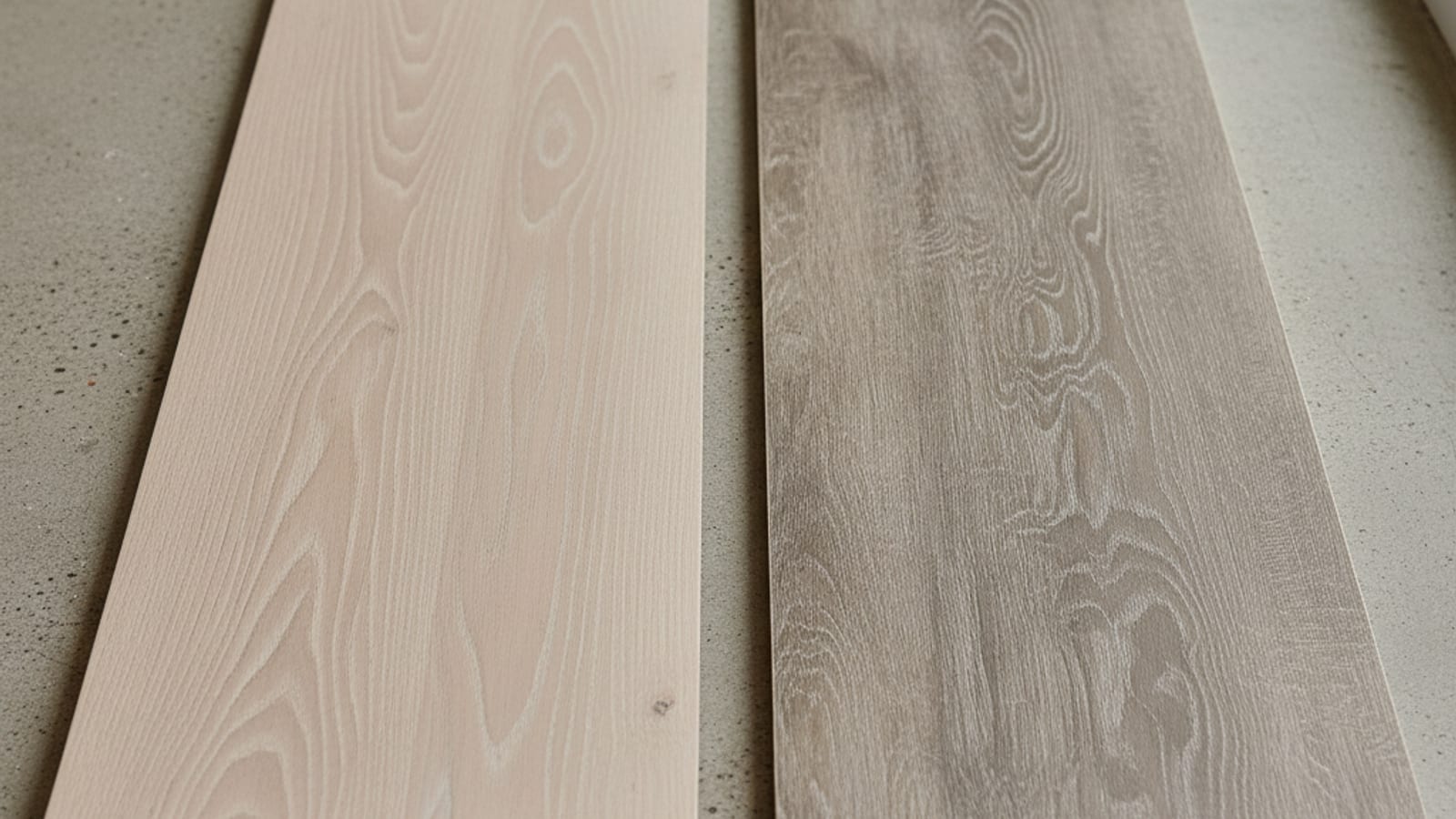
LVP looked cheap five years ago. It doesn’t anymore. Modern rigid-core SPC products from Coretec, Mohawk, Shaw, and Karndean have embossed-in-register textures that match the wood-grain pattern, microbeveled edges, and varied plank lengths. Walking on a quality LVP install, you can tell it’s not real wood, but you can’t tell from across the room, and most guests can’t tell at all.
Hardwood, of course, is real wood. Patina develops. Grain variation is genuine. Sun exposure changes the color over years. There’s a feel underfoot that no synthetic material reproduces, slightly warmer in winter, with a small amount of give that LVP’s rigid core doesn’t have.
For pure aesthetic and feel, hardwood wins on premium spaces. For most secondary spaces, LVP is convincing.
Water resistance
LVP wins outright. Rigid-core SPC and WPC products are waterproof at the plank, water cannot warp or swell the core. Spilled drinks, dog accidents, mopping with too much water, all fine. The seams between planks are not always watertight (a bath overflow that sits for two days will eventually find its way under the floor), but for everyday use, LVP handles water in a way hardwood cannot.
Solid hardwood is the opposite. Standing water, even briefly, causes cupping. Salt residue from coastal humidity damages finishes over time. We advise against solid hardwood in kitchens, full baths, and laundry rooms.
For families with kids or pets, this single factor often decides the question.
Durability
LVP has commercial-grade products with 20-year wear warranties from major brands. In a real home with kids and pets, plan for 15 to 20 years before the wear layer shows. LVP doesn’t refinish, when it’s done, it’s done.
Hardwood, properly maintained, lasts 30 to 50 years. Solid 3/4-inch hardwood can be sanded and refinished 5 to 8 times. Engineered with a 4mm wear layer takes one or two refinishes.
Over a 30-year horizon, hardwood’s refinishing capacity gives it a longer functional life. But that assumes you’ll actually refinish, many homeowners don’t, and the floor wears the same way LVP does.
Slab compatibility
This is the deal-breaker for most San Diego homes built after 2000. LVP can be installed directly over slab with proper underlayment and slab moisture testing. Solid hardwood cannot, the moisture transmission cups boards within 12 to 24 months, and there’s no fix once it happens.
The workaround for slab homes that want hardwood is to install plywood subfloor over the slab first, then nail hardwood to the plywood. This adds $2.50 to $4 per square foot to the install and roughly an extra inch of floor height, which throws off door clearances, transitions, and trim.
For most slab homes, the smarter path is engineered hardwood (which can glue or float directly to slab) or LVP. We’ll measure your slab and tell you what’s possible at the consult.
Resale value
In San Diego County’s resale market, hardwood still pulls more weight than LVP. A real estate agent listing a home with new white oak floors will typically price 1 to 3% higher than a similar home with new LVP. The premium is most noticeable in markets that already trade hardwood as a baseline expectation, Rancho Santa Fe, Coronado, La Jolla, Solana Beach, parts of Carlsbad and Encinitas.
In tract markets (Otay Ranch, EastLake, parts of San Marcos and Escondido) where most comparable homes have LVP or engineered, the resale difference between LVP and hardwood narrows considerably.
Quality LVP doesn’t hurt resale. It’s the dated carpet you’d be replacing that hurts resale. Either upgrade is a meaningful improvement.
Total cost over 20 years
This is where the math gets interesting. Mid-grade LVP at $7 per square foot installed, with no refinishing and roughly $0.20 per square foot per year in maintenance (occasional plank replacement, basic cleaning), runs about $11 per square foot total over 20 years.
Mid-grade solid hardwood at $11 per square foot installed, with one refinish at year 12 ($5 per square foot), runs about $16 per square foot total over 20 years. Higher upfront. Lower ongoing.
For a 1,000 square foot install, that’s $11,000 (LVP) vs $16,000 (hardwood) over 20 years. The hardwood ends those 20 years still able to be refinished one or two more times. The LVP needs replacement.
Different math for different households. We don’t push either direction.
Where engineered hardwood fits
Engineered hardwood is the answer for slab homes that want real wood. The top wear layer is a slice of real hardwood (typically 2mm to 6mm thick), bonded to a dimensionally stable plywood or HDF core. That core lets the floor sit on slab without the cupping risk solid hardwood has.
Quality engineered with a 4mm-plus wear layer can be refinished once or twice over its life. Wide-plank European oak engineered runs $9 to $14 per square foot installed in San Diego, between LVP pricing and solid hardwood pricing, with most of the upside of real wood.
For most slab homes that want the look of wood, engineered is the answer over both LVP and solid.
More detail in our engineered hardwood service page.
How to decide
If you’re still deciding between LVP and hardwood, walk through these questions:
- Is your home on slab or on a wood subfloor? Slab → LVP or engineered. Wood subfloor → all three are possible.
- Pets, kids, high-traffic? Yes → LVP. No → either.
- How long do you plan to be in the home? Under 7 years → LVP often pencils better. 15-plus years → hardwood’s longevity earns its premium.
- What’s your budget per square foot installed? Under $8 → LVP. $8 to $13 → engineered. $11 to $20 → solid hardwood.
- What’s the rest of the home like? Don’t put LVP next to existing solid hardwood that you’re keeping. The look doesn’t transition cleanly. Match like with like.
Want to see them side by side?
Free in-home measure with samples of all three, LVP, engineered, and solid hardwood, so you can see them on your subfloor, in your light, next to your trim. Quote is line-itemed for whichever direction you decide on. Stays valid 30 days.
Call (858) 925-5546 or request a quote.