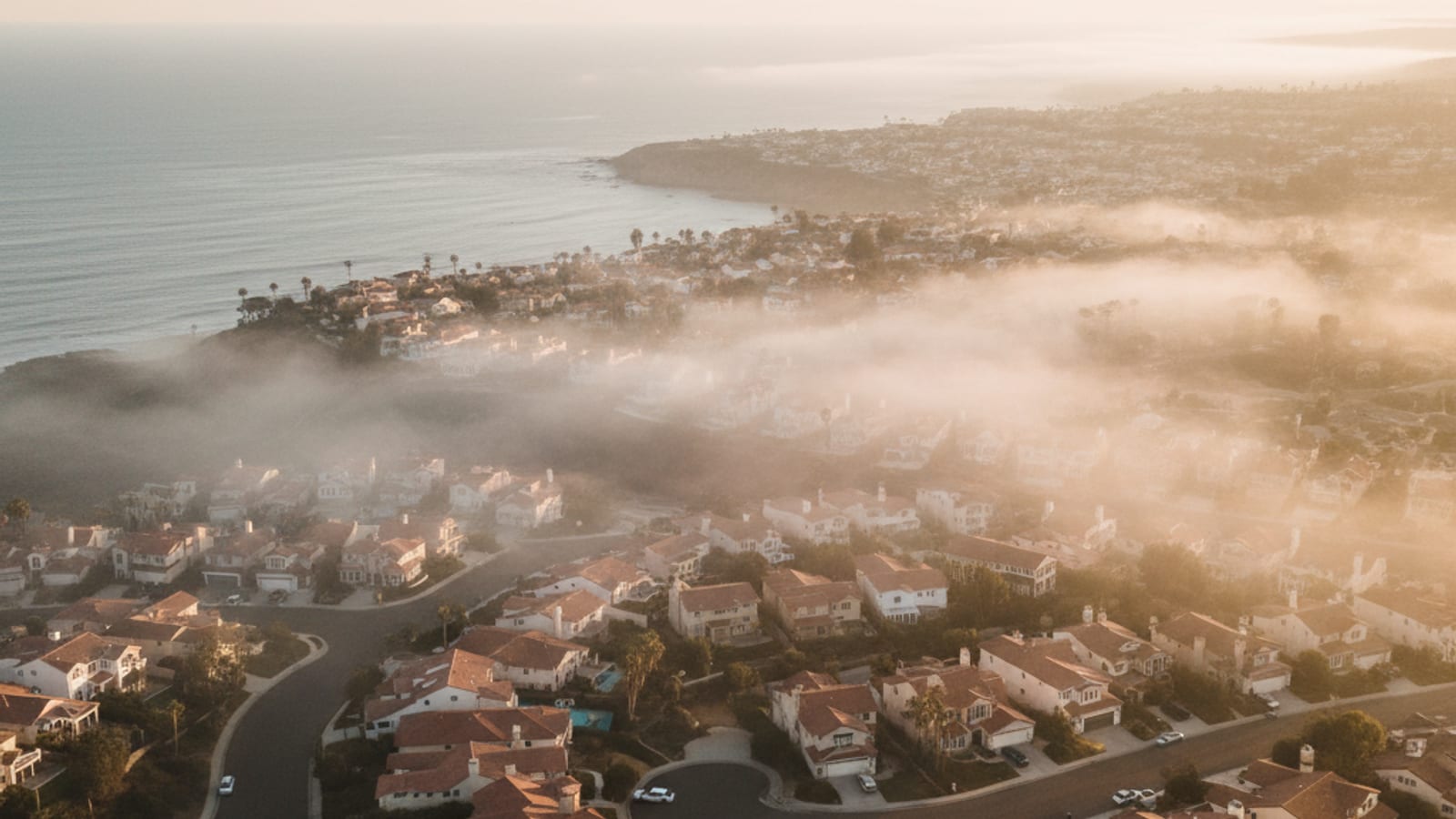
Most flooring failures in coastal San Diego come from a single thing nobody tells homeowners about: marine-layer humidity. Here’s how it affects different products and what to install where.
What is marine layer doing to your floor?
The marine layer is fog and humidity that rolls in from the Pacific most mornings from May through September. Even when the fog burns off, ambient humidity stays elevated in homes within 2 miles of the ocean, typically 60–80% relative humidity year-round, vs. 30–50% inland.
That elevated humidity affects every hygroscopic material in the house. Hardwood floors absorb moisture and expand. Solid wood doors stick. Drawer fronts swell. Anything that’s wood and not properly sealed or stabilized moves with the season.
For floors specifically, three failure modes matter:
Cupping, edges of hardwood boards rise above the center as the bottom face absorbs more moisture than the top. Most common on solid hardwood installed without enough acclimation, or installed over slab without a moisture barrier.
Gapping, boards shrink during dry inland weather (Santa Ana winds, occasional heat events) creating visible gaps between boards. Reverses partially in summer humidity but not fully.
Adhesive failure, LVP, vinyl sheet, and tile adhesives can fail when slab moisture is above manufacturer spec and a vapor-barrier coating wasn’t installed. Edges curl, tile pops loose at corners, sheet vinyl bubbles.
All three are preventable with proper product choice and prep. None of them are fixable cheaply once they happen.
Which products handle coastal humidity well
Engineered hardwood: Wins for most coastal homes that want real wood. The dimensionally stable plywood or HDF core resists the cupping and gapping that destroys solid hardwood. Glue-down install with vapor-barrier adhesive handles slab moisture.
Rigid-core LVP (SPC): Waterproof at the plank, dimensionally stable, indifferent to humidity. Best fit for slab-on-grade coastal homes on a budget. Works in kitchens, baths, mudrooms, anywhere humidity is a concern.
Porcelain tile: Indifferent to humidity entirely. Best for mudrooms, bathrooms, kitchen wet zones, and entries where salt-air foot traffic comes in.
Laminate (limited use): Modern AC4+ laminate has water-resistant edges, but seams are still a weak point. We use laminate sparingly in coastal homes, usually only in dry interior bedrooms.
Which products struggle in coastal humidity
Solid hardwood directly over slab: Cups within 12–24 months. Avoid.
Solid hardwood with rushed acclimation: Even on a wood subfloor, solid hardwood needs 8–10 days of on-site acclimation in coastal homes (vs. 5–7 inland). Skipping this is the most common cause of failure.
Cheap engineered with thin wear layers: 1mm or 2mm wear layers don’t refinish well, and the thin top layer is more susceptible to dimensional movement. Use 3mm+ wear layers in coastal applications.
Sheet vinyl with un-welded seams: Seams allow moisture migration to the substrate. Heat-welded seams handle humidity well; loose-laid sheet vinyl with unsealed seams is a problem.
What we change for coastal installs
Three modifications we make on every install within 2 miles of the ocean:
1. Longer hardwood acclimation. 8–10 days minimum on site, in the room where the floor will be installed, with HVAC running. Sometimes 14 days if pin-meter readings haven’t stabilized.
2. Tighter expansion gaps on solid hardwood. Coastal humidity stays high year-round so boards run wetter. We size expansion gaps for less seasonal swing.
3. Slab moisture testing as a default. Every slab install gets an in-situ probe (ASTM F2170) before quoting. Slabs above the manufacturer’s RH spec get a moisture-mitigation coating before flooring goes down.
What about coastal salt air?
Salt air doesn’t directly damage interior flooring much, the ventilated indoor environment dilutes it before it hits the floor. The exception is at entries: sand and salt tracked in from the beach is abrasive and accelerates wear on any finish.
Mitigation:
- Walk-off mats at every entry, both outside (rubber-backed, breathable) and inside (absorbent)
- Daily sweep or vacuum during heavy beach-season traffic
- Tile or LVP at primary entries where mat-to-mat coverage isn’t practical, both wear better than hardwood under sandy foot traffic
Climate considerations by zone
Coastal homes (within 2 miles of ocean): Engineered hardwood, rigid-core LVP, or tile. Solid hardwood only with extended acclimation and a wood subfloor (not slab).
North Coastal (Carlsbad, Encinitas, Oceanside): Same as coastal. Marine layer reaches inland farther in this zone, humidity stays elevated 6–8 months a year.
Inland (Escondido, San Marcos, Vista, Poway): Drier, more swing between summer and winter humidity. Solid hardwood works well with full acclimation. Engineered and LVP also fine.
East County (El Cajon, Santee, Alpine): Hot and dry. Easier on flooring from a moisture standpoint. Solid hardwood tolerates wider humidity swings than coastal but needs full acclimation.
Mountain (Julian, Pine Valley, Ramona): Vacation properties that sit empty for weeks at a time stress solid hardwood with extended unconditioned periods. Engineered or tile is more forgiving.
How to vet a contractor on coastal install
Three questions:
- How long is acclimation budgeted? 8–10 days minimum for coastal homes.
- Are you testing slab moisture? ASTM F2170 in-situ probe is the right answer for slab.
- Do you adjust expansion gaps for coastal humidity? “Yes” is the right answer.
If the contractor’s process matches all three, the floor will hold up. If not, the cost savings on the install get spent later in repair.
Want a coastal-specific consult?
Free in-home measure across all 67 San Diego County cities, with extra attention to coastal-specific moisture and salt-air considerations.
Call (858) 925-5546 or request a quote.